
Things today are a little bit too easy.
We could do with a little bit more friction.
Like a diamond formed under pressure, humans often do our best creative work, our best creative thinking and take our biggest leaps in identity when there is a bit of friction. When we need to be a bit gritty. When we have to find a new way to do something.
And that’s why I’m asking:
Do we need to take a step back from AI so we can take a big leap forwards?
This is for founders, entrepreneurs and commercial leaders who are using AI to make their businesses faster, slicker and more efficient, particularly in travel and hospitality.
I’ve seen such a broad spectrum of AI adoption in my work with founders and commercial leaders in travel and hotel tech. At one end, there are teams who are only just beginning to have their calls transcribed and summarised. At the other, there are businesses creating websites, pitch decks and fully automated workflows using LLMs and AI agents.
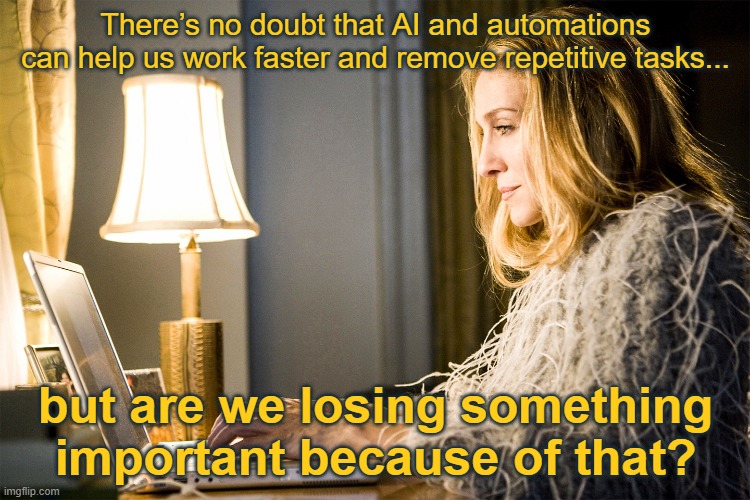
Why does it matter anyway?
It matters because while AI can make your business run faster, there’s a risk that it also makes you more average.
In a world where everyone has access to the same tools, the same LLMs and the same AI agents, being fast and busy and visible isn’t enough.
You need to be distinctive. You need to understand your customers. You need to be able to read other humans. You need to make decisions using your experience and gut instinct.
You need to have wild ideas.
And, crucially, you need to keep upgrading your own mental operating system so you can implement those wild ideas (yes, probably as the operator of some AI agents).
That all requires friction.
Outsourcing your thinking makes you fast, busy and completely indistinct
Ann Handley, speaking at Atomicon, used the hilarious metaphor of a villainous cow and a heroic sloth from an episode of Mighty Mouse to make this point. The speedy cow represents the overuse of AI, with a lack of proper human oversight. This unfettered use of AI for everything leads to silly mistakes, hallucinations and a total homogeny of thought.
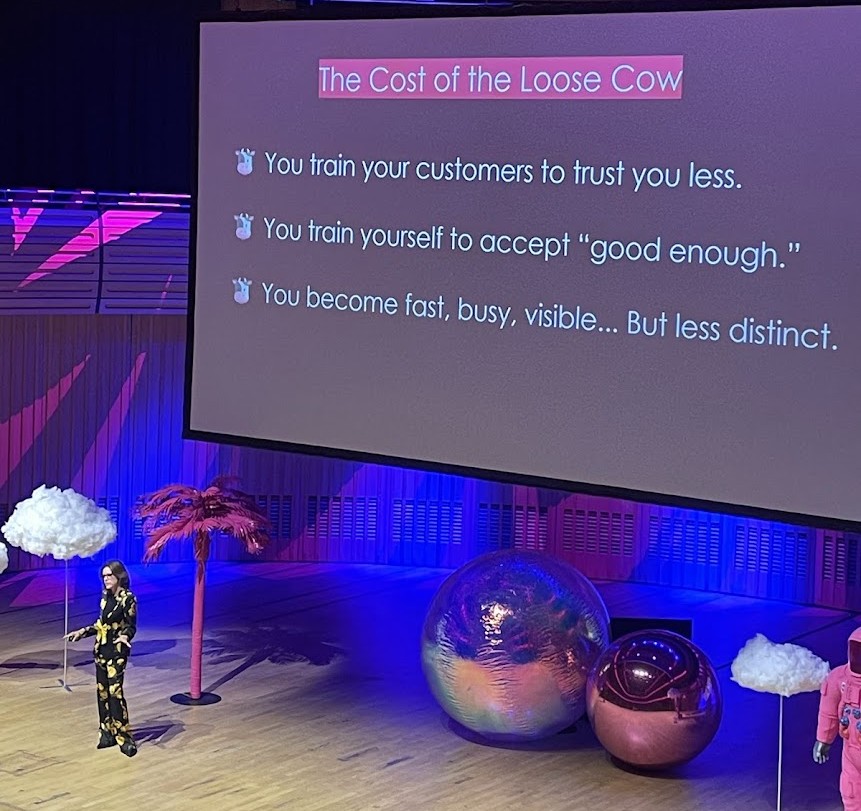
Anne shared the example of Deloitte in Australia, had to refund the goverment $440,000 after writing a white paper, only for it to turn out that most of the expert sources were completely imagined by the LLMs.
And we’ve probably all seen those LinkedIn posts that start with:
“Sure, here’s a 100-word post…”
Or end with:
“Would you like me to make it more casual or more professional?”
OUCH.
Beyond looking a bit silly when that happens, overuse of AI can break trust with your audience or network, because they can’t connect with you through that veneer of AI language.
I’d argue that in marketing especially, outsourcing your thinking takes you further away from understanding your customers and speaking to them in the voice that they recognise. Haven’t we all seen a website that looks perfect, just ‘not for me’? It’s like sliding over teflon, there’s nothing to hang on to or keep us lingering.
In sales, a reliance on AI can zap your confidence and your savviness to read other humans and close a deal. I’ve seen this firsthand in the travel tech startup founders that I coach; they might have super-swish websites, amazing technology that hotels could really do with, and a great investor deck.
But they don’t feel confidence in their product and they don’t trust themselves to sell.
They can miss important human signals in body language and in words that show them opportunities, or where they need to re-evaluate.
There is definitely a time and a place for us to connect human-to-human, use our gut instinct and our human experience to make decisions. When we do the hard stuff ourselves, we can see clearly where we feel really raring to go, and where things feel a little bit sticky.
One of my founder clients shared with me recently that he finds sales really cringey.
After one coaching session, we reframed how selling feels to him. Now he’s excited to sell his product. The difference is night and day and he called it a “come-to-mama moment”.
You can’t outsource that to AI.
You can’t just say to AI, “How do I feel more confident?”
When we ask Chatty or Claudia to create something, of course we make the prompt. There is some creativity involved but we don’t make all those connections in our own brains. And let’s not forget that LLMs are, in many ways, the average of the average. The output will look professional and neat and hopefully correct, but humans don’t connect with professional and correct.
They need to see a bit of their own messy in there to know that you understand them.
Don’t let AI kill your talent pipeline
There’s another interesting angle here, which was discussed at ITT Málaga.
Are we also stifling our own talent pipeline of the future by removing those entry-level travel roles and replacing them with AI agents and workflows?
Travel and hospitality are already chronically understaffed, particularly in frontline roles, and I’d argue that those frontline roles are seen as undesirable precisely because they are repetitive and boring.
You’re dealing with customers who may be pissed off, and you don’t necessarily have the tools to keep them happy.
So yes, AI might replace a lot of tasks but I’d argue that winning businesses won’t simply remove the jobs.
They’ll instead focus their time on upskilling the teams to deliver real hospitality, great account management or great sales. Essentially, we need to stop seeing frontline teams as disposable cannon fodder who need to sink or swim and deal with the sh*t-shovelling.
Instead, we need to see them for what they actually are:
The future of the industry.
I can’t wait to see which businesses step up to the plate and treat their frontline staff as the talent funnel that they actually are.
Use AI for the frictionless stuff and your brain for the stuff that matters
So where should you use AI?
Kevin D. Lyons, another Atomicon speaker, shared a really handy checklist.
AI is great for anything in your business that is:
- Really repetitive and predictable
- The same thing happening every time
- Something you can write out as an SOP or flowchart
- A decision tree where there are only a few possible outcomes
- A process with no nuance or judgement needed
So, normally, not something where an important customer or serious money can be won or lost. And remember that you can and should have human oversight; you can have AI write a draft email rather than send the email, or create an alert rather than make a decision.
Matthijs Welle from Mews said on a recent podcast with Thibault Catala that AI processes have to earn our trust.
This is a good way to start: have them suggest to you what they want to do, so you retain human oversight.
And where should you use your own brain?
When interacting with real people.
- When trying to understand your clients and get closer to them.
- LinkedIn DMs – I cannot TELL YOU how frustrating it is to be in a conversation with an agent, and yes you can tell.
- During client meetings.
- When interviewing clients to really understand how they use your product.
- When networking (and of course, I hope when you’re networking, no one is using AI but I feel like it’s worth saying that it’s a good human practice to do)
- And when creating a strategy to stand out.
Because AI is the average of the average and it will never come up with an original idea in the way that a human can connect the dots.
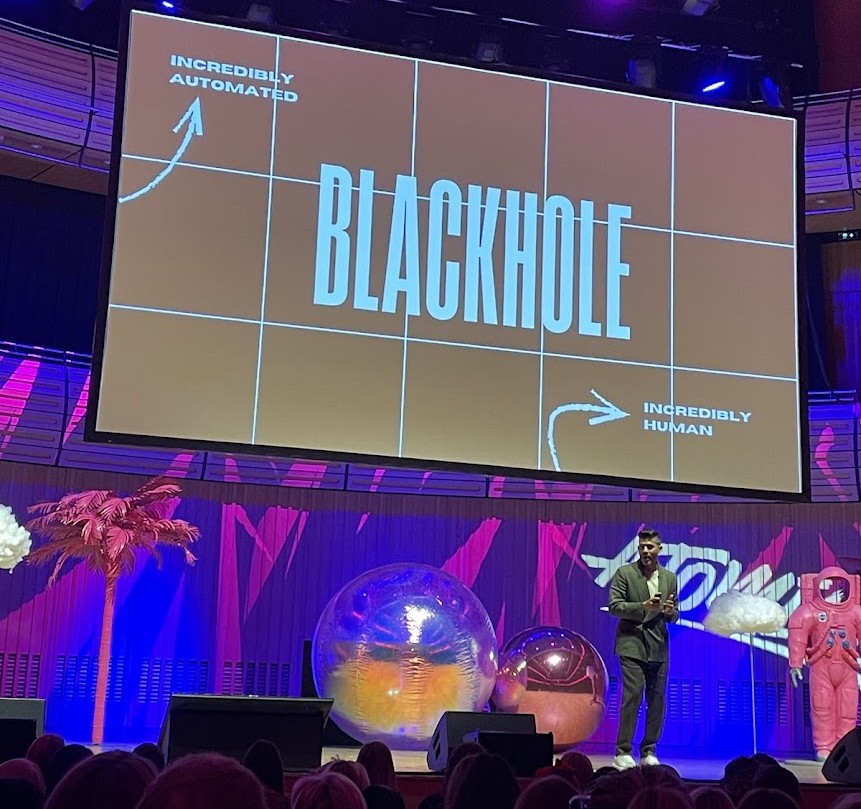
Shawn Kanungo, another speaker at Atomicon, shared a metaphor that I loved:
The black hole of AI mediocrity.
This black hole is the gaping middle where people are using LLMs to outsource their thinking and using AI agents to deal with their clients, even when it really matters.
Your goal should be to have, on one side, your AI processes be extremely slick. Save yourself time and effort where it isn’t needed.
And on the other side, be more human. Actually add more friction when it matters, take more care choosing your clients, and make things feel a bit messy sometimes.
You want to be working on each extreme, not hanging out in the black hole.
Sometimes you really need to have a difficult conversation, trust your gut, and actively repel the wrong-fit clients. Practising making connections in that lovely brain of yours will make you sharper during IRL meetings.
The premium comes from being human in an AI world.
Remember: you are the human operating the AI tools and the AI agents.
You can’t get your ideas from the black hole and then use them to operate the agents, because you’ll just be doing the same as everybody else is doing with the same tools. As the operator of AI tools, you need to have some wild ideas to implement.
And to get wild ideas, you need a bit of friction, creativity, downtime, perhaps a coach or a sounding board. You also need to embody and live inside the problem that you solve for your clients. If everything is “out there” on a pitch deck or a website, you’re not going to feel it when you’re talking to your clients, when you’re selling or marketing to your clients.
And you need to grow your confidence faster than you grow your business, because your business will only go as far as your head will take you.
I know this because I’m doing the same work myself. I could have a business set up by tomorrow through vibe coding and using AI to write my websites. Would I believe in it?
Absolutely not.
You need the practice, friction and to see those real-life nudges and results that set you in the right direction.
So, should we take a step back from AI?
Not exactly. I’m not anti-AI, quite the opposite.
I think we should use AI ruthlessly for the repetitive, predictable, SOP-based work that doesn’t require human judgement. Make those processes slick and save yourself time.
But don’t outsource the things that make you you.
Don’t outsource your thinking.
Don’t outsource understanding your customers.
Don’t outsource your sales conversations.
Don’t outsource your strategy.
Don’t outsource your creativity.
And don’t outsource the uncomfortable stuff that forces you to grow.
Because that friction is doing something; it’s upgrading your mental operating system, building your confidence, helping you connect the dots, helping you understand your customers.
And it’s helping you create something that isn’t just professional and correct, but distinctive, human and yours.
So the goal isn’t to use less AI.
The goal is to use AI to create more space for being human.
And being human means feeling friction.
Recent posts:
- Frictionmaxxing: Do We Need to Take a Step Back from AI to Leap Forwards?
- Balance these four things to be your best self
- The Commercial Velocity™ Map: Why Great Teams Get Stuck
- Founders who are full of beans and self-doubt need go-to-market planning too
- Soar past the Thriving Threshold, with these three steps to career happiness