
And what are we going to do about it?
Our industry has a problem with developing its commercial people.
I know we’ve all seen it: contract managers who get stuck doing the same job for 20 years, area managers who get sidelined or demoted, people demanding you have exactly all the right experience before considering you for a role (even though you’ve proven yourself to adapt in the past), and high performers who have no way to move onwards and upwards.
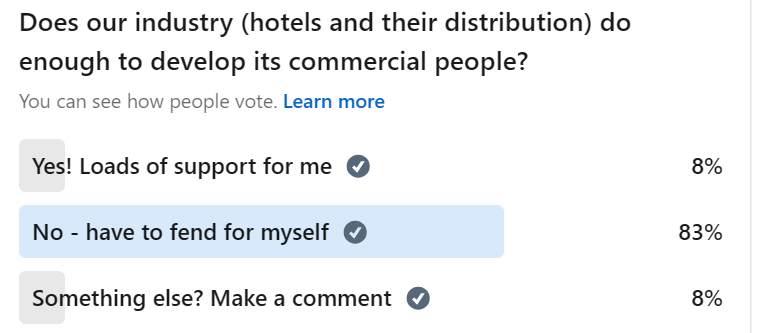
Here’s the tea: 83% of poll respondents said they have had no support in their personal development:
Why is this a problem? Because a lot of creative, caring, ambitious “people people” have got lost, worn out and left behind.
People lose motivation and start to question themselves:
🥲“Am I not good enough?”
😤“Why haven’t I been recognised?”
😩“Why haven’t I progressed when I have worked so hard?”
I have been on both sides of our industry, working both in a global hotel chain and for more than a decade in B2B hotel distribution, and I know there is so much more we can do to develop our people.
I spoke to four industry experts to get their views on what more needs to be done to develop our commercial people, and over the next three editions of this newsletter, I am going to break down what we discussed.
- Samantha Lauver-Marion Director of Global Partnerships at Asian Institute of Hospitality Management
- Colm Flanagan Head of Global Chain Partners APAC at Hotelbeds
- Deepshikha Sehgal Head of Commercial, Bakuun Holdings
- Malcolm Leong Head of Revenue Management and Distribution Strategy at Far East Hospitality Management
What’s the problem?
How did we get here? How have a bunch of caring, creative and numbers-driven “people people” been left to fend for themselves in their careers?
Good leaders are often not supported by higher management, who pile on the pressure to achieve budgets and targets. In bedbanks and tour operators the margins are so low that there is no room for “fluffy stuff”.
New leaders are not taught how to build good PDPs, or that prioritising the development of their team is the foundation for future success. Samantha mentions that “development is not prioritised, especially during peak periods of the year when we focus on output and performance and generating revenue.”
There is a lack of praise and appreciation, and of transparency about promotions and lateral job moves.
Too many hiring managers want to see exact experience (same role, same market), meaning squiggles are nearly impossible.
All this means that people get stuck: “There is no innovation. There are no new ideas. You don’t try new things, because you’re so comfortable in that position, doing the same thing, hitting the same number. So what’s the motivation?” questions Deepshikha.
And let’s not just blame the companies we work for, many of you don’t know what you really want or why you want it. And even if you’re trying to progress, you rely solely on company-provided online trainings to skill up.
If things stay as they are, we will continue to suffer with higher turnover than other industries (60 to 120% annually) and staff shortages which are still at 20 – 30% post-COVID. This means that those who stick around become overworked and overwhelmed, leading to high stress levels and low morale.
Even worse, women and minority groups have even less chance at succeeding in this kind of environment.
Have you ever noticed how many women are in the travel industry, but how few companies have female CEOs?
78% of our industry is made up of women, but only 12% of travel industry CEOs.
We need to change this!
Couldn’t we do more as an industry and as companies if we did better at developing people?
All of us agreed that the onus can never be 100% on your company or your boss to develop you.
“It is 100% the responsibility of the individual because regardless of whether or not somebody encourages it, you must take control of your own life”, says Samantha. “There should be no reason why we are looking to our leaders to be as passionate about our own selves as we are. I have seen great success in my life because I took 100% responsibility for my own development.”
Malcolm suggested that we need to demonstrate that we are the best talent for the company, and worthy of the decent salary we want: “If you’re not challenging yourself to demonstrate that you’re an excellent employee, then it’d be challenging for the owner to say, I really think you should be paid a top technology talent equivalent salary. So I have to demonstrate myself that I need to grow, I need to develop myself and be better. It really goes into your coaching mentality, right? It’s all about growth mindset and not being fixated.”
Deepshikha has a more balanced view: “I was blessed to have the best leaders in the industry. And I feel that a lot of my success is attributed towards them, but that wouldn’t have been possible if I was not willing, or if I didn’t perform or if I didn’t make the mark. I think it’s about 50/50”
I know from personal experience that when I thought I was ready to step up into people management, I wasn’t. I thought that being great at my job, taking on extra work and being dedicated to the company was enough. I was waiting for my well-earned promotion that never came. Only when I took risks, learned more about myself and got better at communicating my unique strengths did I see real progress in my career.
But taking responsibility for your career doesn’t mean going it alone.
“My advice to younger people is to be curious, build your network, and get a mentor. Get someone who’s going to look out for you and I don’t necessarily mean your boss. Having a mentor that can guide you through some difficult situations, and who’s been there and is experienced is invaluable” (Colm)
Your network is your net worth! Leveraging on the knowledge and experience of people further ahead than us means we can progress quicker. By building up your network in a positive and sustainable way, you can progress faster in your career and pay back the favour to others.
Malcolm believes that our industry (and the people in it, meaning you!) need to look outside to learn more: “I think it’s good that we learn from other industries. That cross learning would be useful as opposed to trying to learn only within the hotel industry. That’s one of our major hurdles.”
Everyone I know in the hotel industry loves it, so isn’t it time it started loving us back?
YOU can make a change to your experience and the experience of those around you, by taking control of your own career, seeking support and guidance and embodying a supportive and mentorship attitude to those around you.
If you want some support, like, now! Then set up a free discovery call with me here.
If you want to get real actionable insights into all the topics discussed above and more, subscribe to this newsletter where I will be diving into this on a biweekly basis.
Recent posts:
- Soar past the Thriving Threshold, with these three steps to career happiness
- Three things that make NOW the right time to take control of your career
- Want to fly in your career? Then you need to know your superpower
- When working with me won’t work for you
- How to transform your career with this one process
Leave a Reply